Defalco Dealings / On Our Radar
France's Breaking Point: Why Student Protests Became a National Revolt
FRANCE | ON OUR RADAR | 19 OCTOBER 2026
France's latest unrest began with a remarkably ordinary grievance: children were arriving at schools that did not have enough teachers, adequate facilities or a convincing route to the future. Then the anger widened.
What started the protests?
From late September, French secondary-school pupils demonstrated over staff absences, long school days, overcrowding, deteriorating classrooms and the opacity of university admissions. Students described missing significant amounts of teaching when vacancies and absences went unfilled. Those are education complaints, not an attempt to stage a national political revolution.
But the movement found a receptive audience. Trade unions, workers, Yellow Vest activists and others joined demonstrations as fuel costs, wages, pensions and public-service standards rose up the agenda. An education protest became a larger test of whether the French state could still deliver what its citizens expected.
17 October: the turning point
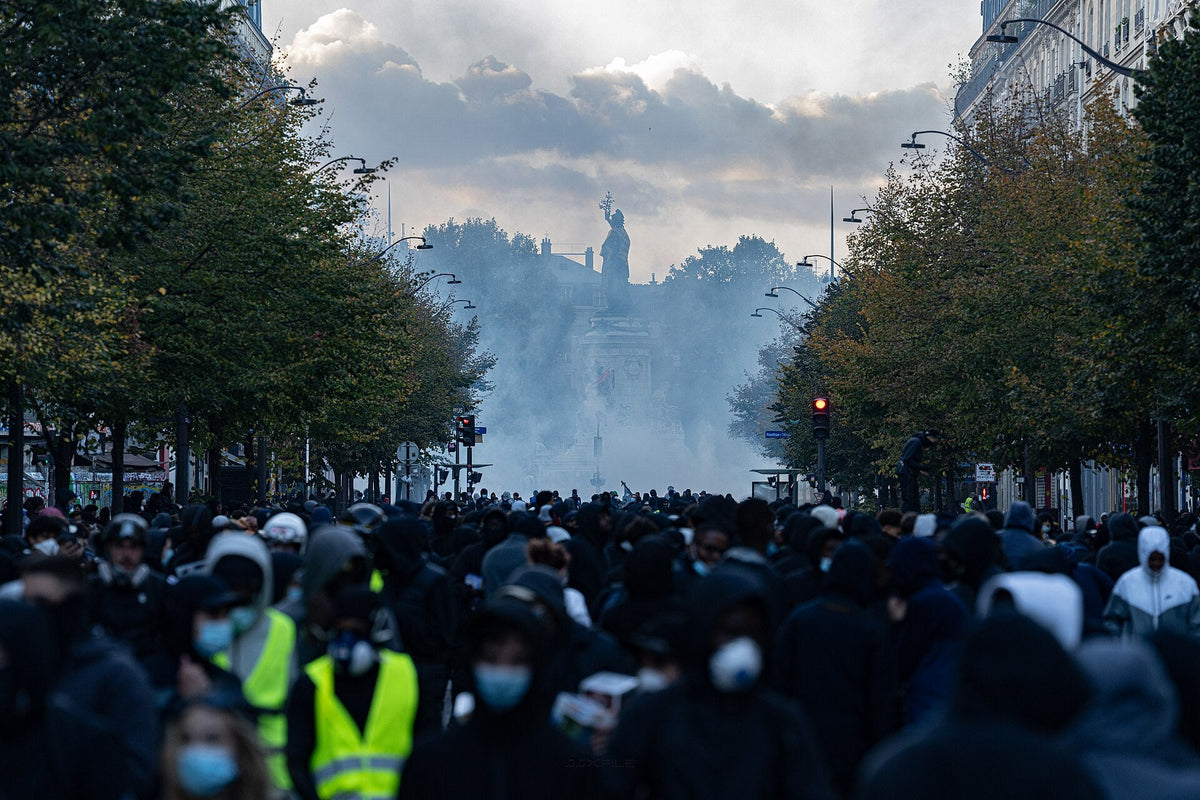
On Saturday 17 October, France experienced mass nationwide demonstrations. Al Jazeera reported that the Interior Ministry counted more than 550,000 participants; other estimates differ. Many people marched peacefully. Yet in cities including Paris, Lyon, Marseille and Limoges, violent groups looted premises, damaged buildings and fought police. Limoges's historic town hall suffered severe fire damage. The devastation, particularly in central Paris, dominated international coverage.
By 19 October, Reuters reported that police had arrested around 2,400 people in connection with the weekend unrest. Such figures are fluid and should not be mistaken for convictions. Reports of significant injuries and concerns about police riot-control weapons also demand scrutiny, not dismissal.
A nota de campo
Do argumento à ação.
Use o artigo como ponto de partida para as suas próprias perguntas.
Macron's difficult position
President Emmanuel Macron condemned attacks and looting while distinguishing those actions from genuine peaceful grievances. His government has promised 3,000 additional substitute teachers, according to the Guardian, and withdrew planned increases to certain university fees. It has also discussed limited local curfews and additional security measures. These steps may answer part of the immediate crisis; they cannot automatically solve the bigger conflict over living costs.
France's budgetary room is constrained by debt and political fragmentation. That matters because calls for higher wages, better schools and reduced household costs carry substantial fiscal implications. The government must explain what it will fund, what it will change and how it will pay for those changes. Protest leaders must also confront that arithmetic.
The temptation to reduce everything to violence
Violence is newsworthy, particularly when businesses and public buildings are attacked. Yet measuring the movement only by the worst images would obscure the first weeks of student mobilisation. Conversely, treating the damage as a harmless by-product of protest would trivialise what shop workers, residents and emergency services experienced.
France has lived through major protest cycles before, including the Yellow Vests from 2018. This one has distinctive ingredients: an unusually prominent secondary-school generation, an energy-price shock, and a president approaching the end of his final term.
What to watch next
Watch whether schools actually receive substitute staff, whether organised unions broaden or narrow their demands, whether proposed local public-order restrictions remain proportionate, and whether any political party can offer a workable financial programme rather than a slogan. France's presidential election is scheduled for April 2027, making each response politically consequential.
When the school system becomes the starting point of national protest, the question is no longer just what the country costs. It is what kind of future it offers.
For the cross-border picture, read Why Europe Is in the Streets.
Sources & editorial note
- Reuters — France in turmoil, 19 October 2026
- Reuters — National demonstrations, 17 October 2026
- The Guardian — European protests explained, 18 October 2026
- Al Jazeera / AFP / AP / Reuters — Protest coverage, 17 October 2026
Reporting cut-off: 19 October 2026. Arrest and turnout numbers are attributed to contemporary reporting, not presented as final. Cover image: Paris, 17 October 2026, Jorge Jaramillo / JJxFile via Wikimedia Commons, CC BY-SA 4.0.
Leve a leitura para a vida real
Três ideias a reter.
Esta lista não envia as suas seleções. É reposta ao recarregar a página; assinalar uma caixa não avalia competências.
Moving to Italy: how to plan a useful scouting trip
A three-day research itinerary for comparing everyday life in two Italian neighbourhoods, with practical checks for housing, transport, work and community.
Ler o artigo →Find your Defalco Dealings guide: relocation, cities, language and preparedness
Choose the right Defalco Dealings format for your move, trip, first conversations, household planning or personalised research brief.
Ler o artigo →Build an offline planning folder before you need it
A straightforward way to organise useful documents, household checklists and preparedness reading without turning preparation into a prediction.
Ler o artigo →